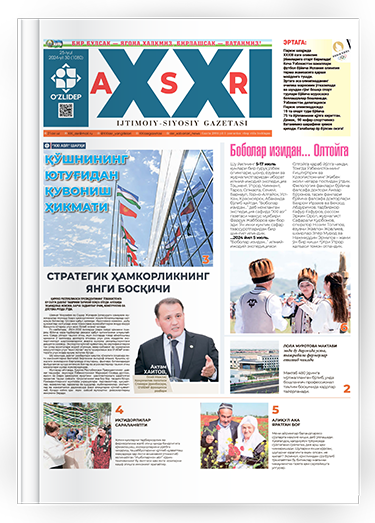





New growth drivers for Andijan’s economy
Today, Andijan is entering a new stage of economic development. For a region with a population of more than 3.5 million and limited land resources, using existing opportunities efficiently is particularly important. The changes underway are also reflected in the region’s economic indicators.
In the first half of this year, the regional economy grew. In particular, the economy expanded by 8.8%, industrial output by 9.2%, and the services sector by 16.1%. An 8.9% increase in investment indicates that new enterprises and production facilities are being established and that business activity is continuing to grow.
The 206 investment projects launched or put under construction during the President’s visit to Andijan region can also be regarded as future growth drivers for the regional economy. Their total value amounts to $9.4 billion. Of these, 98 projects worth $2.05 billion have been commissioned, while construction has begun on another 108 projects valued at $7.35 billion.
Most importantly, the projects are not focused solely on industry but span interconnected sectors, including energy, mechanical engineering, textiles, construction, pharmaceuticals, logistics, tourism, education, and healthcare. This will help develop the regional economy into a stable, diversified system supported by several key sectors.
In terms of their economic significance, once fully implemented, the projects are expected to create more than 45,000 jobs, generate annual production worth 60.6 trillion UZS, and create export capacity of $533 million. For Andijan, this represents an opportunity that goes well beyond the investment volume itself: a new economic base will emerge for processing local raw materials, developing new technological value chains, producing export-oriented goods, and increasing labor productivity.
Projects producing electric buses, solar panels, micro-hydropower equipment, furniture, and leather and footwear products also show the structural transformation underway in Andijan’s industrial sector.
Fully unlocking Andijan’s economic potential cannot be measured solely by the number of new enterprises. Every investment should generate more value from each hectare of land, create higher-income jobs, and open new opportunities for entrepreneurship.
If the production and service capacities being developed under the 206 projects are effectively integrated with the region’s existing industrial expertise, entrepreneurial potential and human capital, the impact of economic growth will become even broader. Ultimately, this process will reach local communities through new jobs and higher incomes, helping translate Andijan’s economic growth into improved living standards for the population.
At the meeting held during the visit to Andijan, participants set key tasks to further develop the regional economy, increase investment, support entrepreneurship, and raise household incomes.
Key priorities include further accelerating economic growth and ensuring its benefits are reflected in people’s daily lives. In the first half of this year, the regional economy grew by 8.8%. During the same period, industrial output increased by 9.2%, while the services sector expanded by 16.1%. Investment attracted to the region rose by 8.9%.
The priority tasks outlined to strengthen the region’s economic potential are intended, above all, to increase production, expand export opportunities, create new jobs, and improve public well-being. The 2027 targets – achieving at least 10% economic growth, attracting $5 billion in investment, and increasing exports to $1.5 billion – are expected to stimulate job creation and contribute to higher household incomes.
Developing entrepreneurship and expanding access to financial support for projects are key drivers of economic growth. In this regard, introducing new lending approaches – assessing not only collateral but also an entrepreneur’s cash flow, contracts, orders, and turnover, and providing loans of up to 500 million UZS without requiring a business plan – is particularly timely. These measures are significant because they will help boost entrepreneurial activity, facilitate the implementation of new projects, and stimulate economic growth.
Overall, the effective implementation of the tasks set during the Head of State’s visit to the region will, above all, help create new jobs in mahallas, promote employment, increase household incomes, and open new opportunities for entrepreneurs.
Members of our faction will pay particular attention to further strengthening parliamentary and public oversight mechanisms to ensure that the tasks set are implemented effectively at the local level, that allocated resources are used efficiently and for their intended purposes, and that every project and initiative carried out serves the interests of the population.
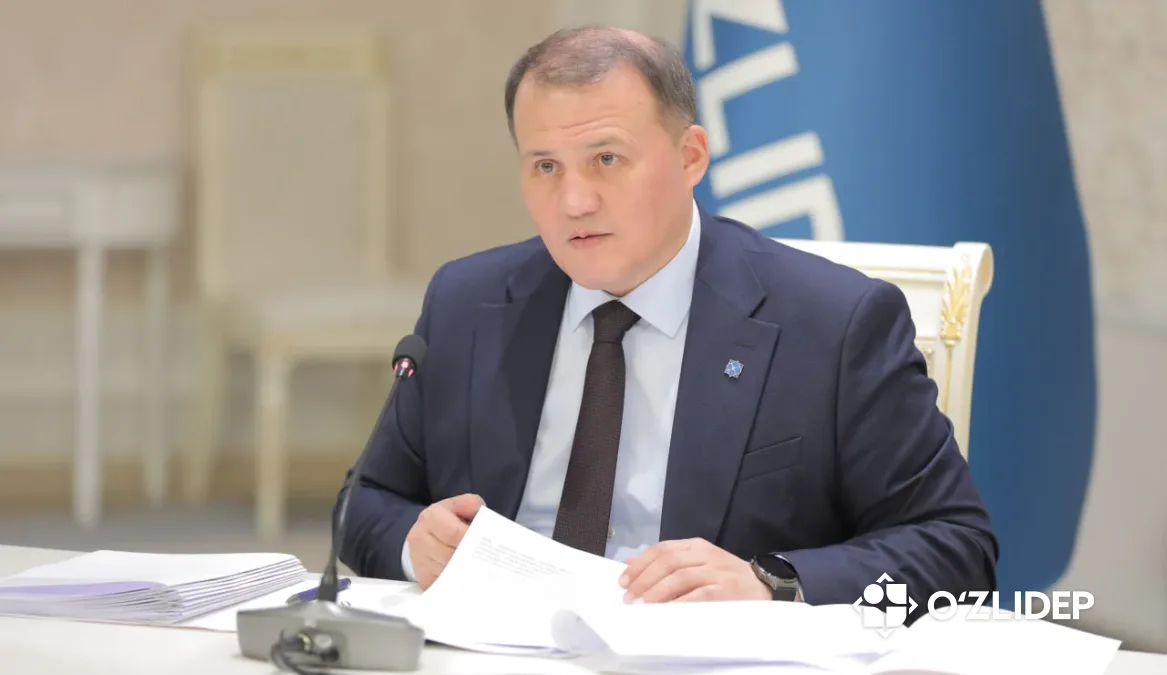
Aktam Khaitov
Head of the UzLiDeP Faction
in the Legislative Chamber of the Oliy Majlis